
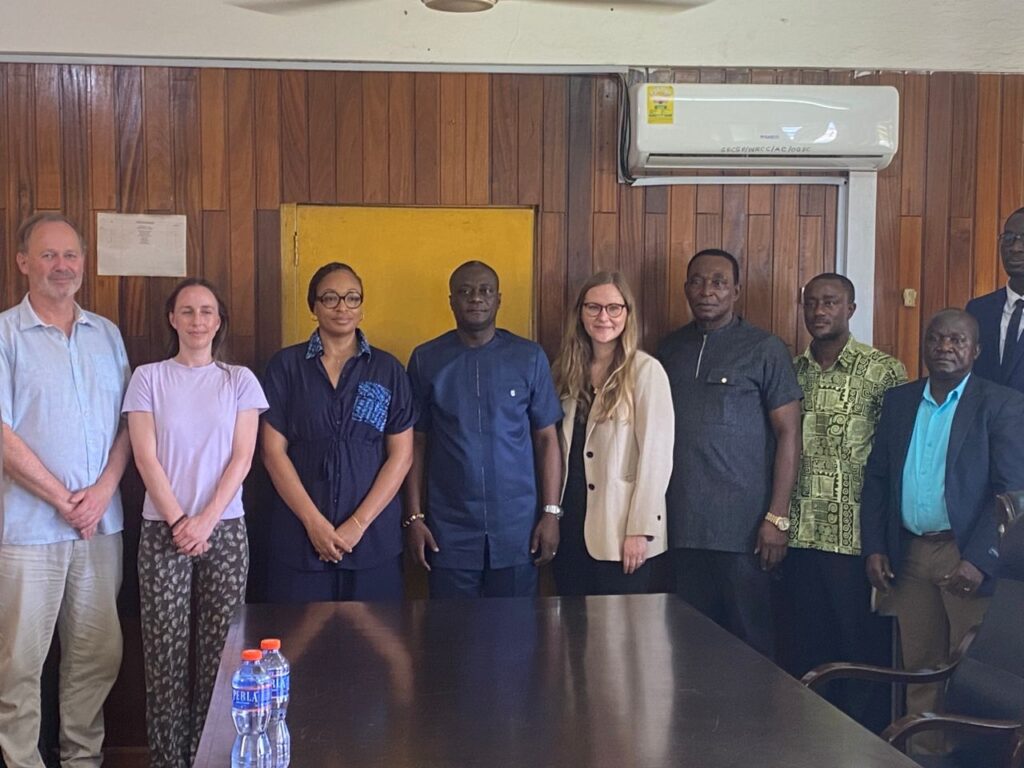
The Sekondi-Takoradi Metropolitan Assembly (STMA) has hosted a high-level delegation under the Urban and Municipal Development Fund (UMDF), as part of the African Cities Program of the African Development Bank (AfDB), in a field mission aimed at assessing priority urban development projects and infrastructure challenges in the metropolis. The two-day engagement, which included meetings in Accra and field visits in Sekondi-Takoradi, brought together government officials, development partners, and metropolitan authorities to review ongoing initiatives and identify areas requiring financial and technical support.
Speaking during the engagement, the STMA Project Coordinator, Ing. Michael Dzisi, explained that the metropolis applied to join the African Cities Program under the African Development Bank, with preparatory studies beginning in August 2025. He noted that the current visit by AfDB officials and donors was crucial for providing a first-hand understanding of the city’s development challenges. “Today’s visit is for the bank officials and donors to come and see the challenges we are talking about and seeking support for,” he said.
He identified waste management as one of the most urgent urban challenges facing Sekondi-Takoradi, stressing that it forms a central component of the proposed interventions under the program. According to him, the Assembly is working toward introducing a structured waste segregation system at the household level, designed to improve recycling and reduce landfill pressure. “We are going to introduce a three-bag source separation system so that every household will be given three different bags, for organic waste, plastics, metals, and other materials,” he explained.
He added that organic waste would be processed for decomposition, while recyclable materials such as plastics, metals, and glass would be converted into useful products capable of generating revenue. Ing. Dzisi noted that the current volume of waste generated in the metropolis is unsustainable, stressing the need for a shift toward recycling and circular waste management systems.
As part of efforts to improve waste management practices, he revealed that a five-member team from STMA will travel to Denmark for a three-week study programme beginning later this month. The team is expected to study advanced waste management and recycling systems, with the intention of replicating successful models in Sekondi-Takoradi. “This situation we see behind us is not healthy and it is not sustainable,” he stated, adding that international exposure would support the city’s transition to modern waste management systems.
Beyond waste management, STMA has identified 40 development projects, with five key priority interventions currently being advanced. These include major market redevelopments, transport infrastructure upgrades, and agricultural development initiatives. Key market projects include the redevelopment of Market Circle in Takoradi, as well as Kojokrom, Essikado, and Kansaworado markets.
On transport infrastructure, Ing. Dzisi outlined plans to decongest the central business district through the development of new transport terminals. These include:
- A proposed terminal at Nkroful Junction
- Expansion and redevelopment of the Beech Road taxi station into a five-storey car park complex
- Development of Main Spin as a transport terminal
- Construction of a haulage terminal at Sofokrom to address truck congestion linked to port activities
He explained that these interventions are designed to reduce congestion, improve mobility, and support commercial activity within the city.
The STMA Project Coordinator further highlighted plans to develop an agro-based project in the northern part of the metropolis, aimed at strengthening food security. The proposed agri-village near Mampong will support both crop and livestock farming, with technical assistance, improved seeds, and equipment provided to farmers. He explained that integrating livestock and crop production would also enhance soil fertility through the use of organic manure, promoting sustainable agriculture. Additionally, STMA is planning institutional capacity strengthening initiatives, including staff training, logistics support, and expansion of office infrastructure to improve service delivery.
The Mayor of Sekondi-Takoradi, speaking during a media engagement, emphasized the critical importance of the city’s landfill site, noting that it plays a central role in waste management across the metropolis. “This landfill site is where all the waste collected in the city is brought to. If there is any problem here, there will be problems in the city,” he said. He cautioned that waste accumulation in the city is often a reflection of challenges at the landfill level.
The Mayor further disclosed that waste management in the metropolis is capital-intensive and requires significant investment, adding that the Assembly is currently operating with limited equipment and resources. He appealed for increased support from development partners, stressing the need for external assistance to improve sanitation infrastructure. “We are doing our best as an Assembly, but we need partners to come to our aid,” he said.
He encouraged the delegation to communicate the realities of the situation to the public to ensure better understanding of the challenges involved.
The Western Regional Minister, Honourable Joseph Nelson, who welcomed the AfDB delegation, described Sekondi-Takoradi as the only metropolitan assembly in the region and a key hub for development. He emphasized the city’s strategic importance as part of the regional capital and expressed appreciation for its inclusion in the African Cities Program.
He noted that the selected projects, including sanitation, markets, and transport terminals, are critical to improving the lives of residents. “These are key projects that will impact the lives of the people,” he said, expressing hope that the field visits would strengthen the case for funding support.
The Minister also encouraged development partners to support implementation efforts, noting that successful execution of the projects would significantly improve urban living conditions in the metropolis.
The UMDF mission forms part of broader efforts to strengthen urban resilience, improve infrastructure, and promote sustainable development in secondary cities across Africa. For Sekondi-Takoradi, the engagement marks a critical step toward securing funding and technical support for long-standing challenges in waste management, transport congestion, market infrastructure, and urban planning.
If approved, the proposed interventions are expected to reshape the city’s development trajectory and improve living conditions for thousands of residents.